The blog is now located here:
http://makingakillingwithcollectibles.com/
Please click the link for more updated entries.

Welcome. The purpose of this blog is to facilitate the development of a book I'm writing about techniques for building a valuable collection of most any type of collectibles through intelligent purchases, profitable sales, and "flipping".
Sunday, March 24, 2013


Tuesday, March 19, 2013
How To Get Free Stuff / Trading Chains / Challenge
If you’ve been reading this blog, by now you should have
some pretty good ideas about how to make a killing with collectibles. But even with plenty of “wins”, buying
collectibles can put a strain on your wallet.
I recently bought a dog-eared copy of Amazing Spider-Man #1
at a comicbook convention.

This comicbook is considered a collector’s Holy Grail. Yet, the reality is that I didn’t pay much
for it. I did shell out some money, yes,
but more than half of my purchase was taken in trade. I traded four very nice comicbooks, plus a
handful of cash for my Spidey #1. But
I’m sure you can guess, I didn’t pay much for the comicbooks I traded. In fact, much of the money that I spent on
that comicbook came from sales of other comicbooks over the internet, and even
those were purchased at a discount. In
total, I estimate that I probably actually pulled about ¼ of the purchase price
from my household income. The rest of
the money came from labor…buying and selling collectibles of all types.
So let’s follow this method of buying great collectibles to
its conclusion and put it to the test.
Imagine this. I have a
collectible worth close to $100. I sell
it for $100. Then with that money, I
focus on buying another collectible worth 50% more than my purchase price. I then turn around and sell that item worth
$150 for $130 to facilitate a quick sale.
Now, what do I do with the money?
I pull my original investment of $100 off the top. That leaves me with $30 profit. Next, I take 1/3 of the profit ($10) and put
it with the $100, so I now have $110 to spend.
So if I keep doing this, I will get to dabble in more and more expensive
collectibles. The other $20 is saved for
a future purchase of a collectible I want to keep. Here are the steps again laid out:
- Sell a collectible (rare currency) for $100. This is my “purchase money”
- Use the “purchase money” to buy another collectible (a comic book) that is worth at least 50% more…so let’s say I buy something worth $150 for $100.
- Now I sell the new collectible (the comicbook) at a discount to its value for $130.
- I take back my “purchase money” ($100) and I add 1/3 of my profit to it ($10). So now my new purchase money is $110.
- I put the $20 aside for the next item that I want to buy and keep (after all, I am a collector of things!)
- Now I keep going. I take my purchase money of $110 and I get lucky and buy something worth $200.
- I sell the $200 item for $170. My profit is $60. So I take 1/3 of the profit ($20) and add it to my purchase money ($110), so now I have $130 of purchase money for the next flip.
- And I set aside the remaining profit of $40 and add it to the previous $20 I already set aside…so now I have $60 to buy and hold the next item I really want.
Is this REALLY getting collectibles for free? No, because I’m earning the money. I just don’t think of it as work because I
enjoy buying and selling collectibles.
The eight steps above are what I would call a “Trading
Chain”. I just made that up…nifty,
huh? The thing is, if you do a trading
chain, it can get downright boring waiting for your item to sell. But there is a solution to that problem….two
trading chains! A guy could run multiple
trading chains and have some fun doing it.
So what about putting it to the test?
Here’s what we’ll do.
I have about ten comicbooks. They
are the Walking Dead comicbook series.

The beautiful thing about them is that I bought them all for a cover
price of $3 each after I knew they were worth at least double what I paid for
them. Since then the price has risen
some more. So I will donate those comics
to this test. I have a person who is
indicating that they want to buy them now.
So as of today (3/19/13 )
they will be my seed money. Whatever I
sell them for will become my “purchase money”.
So check back with this thread on my progress. I will document the steps below:
- About a year ago, I bought ten comics for $30.
- The ten comicbooks are now for sale and proceeds will be my “purchase money”.
- ??? What’s next? Stay tuned.
Sunday, August 12, 2012
This blog has moved to http://makingakillingwithcollectibles.com/
We moved to http://makingakillingwithcollectibles.com/ . I like blogspot, but it has some shortcomings I just have a problem with based on my presentation style. We'll still be writing about comic books, coin collecting, collectibles, currency (paper money), old video games and economic theory about investing in collectibles.
Monday, June 25, 2012
Am I A Shrewd Buyer or the Greater Fool?
I just posed a question to a currency forum that I like to frequent. I stated that I just won a hotly contested auction, and I asked if I was a "greater fool" because I was willing to pay more than anyone else.
I then gave my reasoning that if I win an item in an auction, I only paid a few dollars more than the next lowest bid (AKA: "the underbidder"). Therefore, I could sell it to him for almost as much as I bought it for.
Another forum member shrewdly pointed out that I could only get the same kind of money if there was yet another person who would act as an underbidder to my underbidder. Very true if I sell in an auction setting. So am I a greater fool?
I say no. Because it depends on what you buy. I purchased an a drop-dead gorgeous 1935 Canadian Bank of Commerce $5 Note in the collectible grade of Extremely Fine. True, I didn't buy the highest grade available, but I don't always have alot of funds to spend on stuff like this because I have this terrible habit of keeping everything I buy instead of recycling cash to buy the next thing.
As I see it, I "hit the trifecta", because the item I bought is (1.) Desireable because of it's beauty, (2.) It is somewhat rare (3.) It is a higher grade. Those are the three components of what makes a good collectible, and when you have all three working for you, the collectible will tend to rise in price nicely over time.
But here's the last piece of the puzzle. I didn't overpay. I did my research on what these beautiful notes sell for, and I put in a bid that was high enough to hopefully win, but not so high that I would overpay. In fact, my bid was entered such that if I won, I would get a good deal (I did!). Did I get a Super Deal? No. But when you are buying an item that has the trifecta, it is really very hard to find a "Super Deal"...there are just too many people looking for it. I can say that my winning bid was only $8 from my maximum bid. If it went higher than that, I'd would have had to wait for the next one to come along, but that would be OK, because I'm not in a hurry. If I didn't buy this one, then I've have more money saved up to spend on soething else. But even then, I would stay disciplined and not overpay.
So am I the greater fool? No. Because I did my homework and I didn't overpay. I remained disciplined. And the item that I bought had the trifecta of condition, rarity, and wow-factor going for it. True, I might have to hold it for a while to make a profit, but this when and item has all three components of what makes a collectible great, holding onto it is a pleasure.
Collector Steve
Wednesday, May 9, 2012
A new milestone
Today we hit 1,000 views and this is my 25th post/entry. I hope all of you are enjoying this blog. When you log into the blog, don't just scroll down and read what is there. Also click on the links on the right side of the page and read the archived stuff. Some of the better articles, IMHO, include:
"A time machine and $800"
The article about buying slabs is very informative
The article about getting stuff for free is good
There is an article about buying an 1839 Large Cent or a 1939 Nickel that pertains to all collectors regarding making a good purchase.
"Those are Hot Right now" is good advice.
So read, read, read! And for gosh sakes, please comment on the posts. People want to hear what you have to say about these concepts.
Collector Steve
Wednesday, May 2, 2012
How Many Reasons Are There To Buy That Thing?
Over the long term, some collectibles increase in value nicely. Some of them just languish. You can have a lot of fun collecting items that don't increase in value very much, but when it comes time for you to sell, or your family to sell your collection on your behalf after you're gone (Yikes!), it would be nice if your collection was filled with those items that increased in value handsomely.
There are many ingredients in the soup that makes up the future performance of collectibles. One of the strongest ingredients is good demographics. If you collect what the young folks want to collect, you'll probably do fine. But let me tell you about a simplistic way to evaluate them.
LET ME COUNT THE WAYS...
In simple terms, if a collectible has multiple reasons...multiple aspects of attraction...to be a desireable collectible, it will probably do pretty well.
Let me give you an example...look at this comic book:
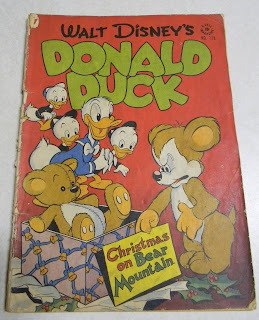
This is a copy of Four Color Comcs #178. It is the first appearance of Scrooge McDuck. It's worth about $125 in that condition. Why is such a dog-eared book worth so much. Let's count the ways:
1. It's a neat looking cover. Come on! That bear is so cute, and the fact that he's angry makes him even cuter.
2. It's an IMPORTANT book in the series. This is the first appearance of Scrooge McDuck!
3. It's rare. Not a lot of these out there.
4. Interestingly, another reason is that it has "cross-over appeal". It is an item that would be desireable not just to a comic book collector, but also to a Walt Disney Item ("Disneyana") collector.
So we have four reasons why it is desireable. But what if it had all four of those reasons, but it was in high grade? High grade comics are also collected for that aspect alone. Then it would have FIVE reasons why it was desireable. FIVE is more than four, so we'd expect it to be worth more.
Now let's look at another one:

This is Vault of Evil #1. In the condition shown, it's worth $10 to $20. Let's count the reasons why it's a good collectible:
1. It's got a cool cover! Come on man, a WEREWOLF! That's just neat.
2. It's a nicer grade. It's not mint, but it's certainly nicer than the Four Color, right?
3. And....umm....hmmm.... Ok, I'm drawing a blank here. Maybe because it's a first issue??? Though that's not too important in a short, otherwise unimportant series, right?
So in summary, I can really only think of TWO reasons why it would be considered a good collectible. Two is certainly less than Four, so over the long term, this might not do as well as the Four Color, but, in fairness, for it's age, it did OK for the owner's initial 20 cent investment. ***See my blog article about the 1839 Large Cent and the 1939 Nickel where I discuss the ages of collectibles and it's bearing on value***
However, the thing to walk away with is that there are only Two really good reasons to seek it out. There are other comics with more than two reasons that might be a better choice over the long term.
Now let's look at the most valuable comic book out there. A near mint copy of Action #1, which sold recently for $1.5 million. Wow! Crazy money! But let's count the reasons.
1. First Superman Appearance (very important)
2. First Superhero Appearance (extremely important)
3. Very Rare
4. It has a very cool cover (trust me).
5. It is in very high grade
6. There are many other firsts, such as the first super strong character, first character to wear his underwear outside his tights :), first mention of Ma & Pa Kent., etc.
7. It has a track record of steady increases in value. This can be a good reason to buy something, but it can also be a reason that a price bubble is forming...the difference is often based on how fast the price is rising.
OK, so I count several reasons why an Action #1 would be considered desireable. So it's the big winner in our counting contest.
The point here is not to just count the reasons why something is desireable and use that as a valuation tool. It's not a valuation tool. But it is a good screening tool for separating the pearls from the lowly peas. If the collectible you're contemplating purchasing is desireable for only a couple of reasons, you might want to keep shopping. If you find an item where you can think of several reasons why it would be good, like condition, cross-over appeal, rarity, it's "cool factor", then it will probably increase in value nicely over time.
There are many ingredients in the soup that makes up the future performance of collectibles. One of the strongest ingredients is good demographics. If you collect what the young folks want to collect, you'll probably do fine. But let me tell you about a simplistic way to evaluate them.
LET ME COUNT THE WAYS...
In simple terms, if a collectible has multiple reasons...multiple aspects of attraction...to be a desireable collectible, it will probably do pretty well.
Let me give you an example...look at this comic book:

This is a copy of Four Color Comcs #178. It is the first appearance of Scrooge McDuck. It's worth about $125 in that condition. Why is such a dog-eared book worth so much. Let's count the ways:
1. It's a neat looking cover. Come on! That bear is so cute, and the fact that he's angry makes him even cuter.
2. It's an IMPORTANT book in the series. This is the first appearance of Scrooge McDuck!
3. It's rare. Not a lot of these out there.
4. Interestingly, another reason is that it has "cross-over appeal". It is an item that would be desireable not just to a comic book collector, but also to a Walt Disney Item ("Disneyana") collector.
So we have four reasons why it is desireable. But what if it had all four of those reasons, but it was in high grade? High grade comics are also collected for that aspect alone. Then it would have FIVE reasons why it was desireable. FIVE is more than four, so we'd expect it to be worth more.
Now let's look at another one:

This is Vault of Evil #1. In the condition shown, it's worth $10 to $20. Let's count the reasons why it's a good collectible:
1. It's got a cool cover! Come on man, a WEREWOLF! That's just neat.
2. It's a nicer grade. It's not mint, but it's certainly nicer than the Four Color, right?
3. And....umm....hmmm.... Ok, I'm drawing a blank here. Maybe because it's a first issue??? Though that's not too important in a short, otherwise unimportant series, right?
So in summary, I can really only think of TWO reasons why it would be considered a good collectible. Two is certainly less than Four, so over the long term, this might not do as well as the Four Color, but, in fairness, for it's age, it did OK for the owner's initial 20 cent investment. ***See my blog article about the 1839 Large Cent and the 1939 Nickel where I discuss the ages of collectibles and it's bearing on value***
However, the thing to walk away with is that there are only Two really good reasons to seek it out. There are other comics with more than two reasons that might be a better choice over the long term.
Now let's look at the most valuable comic book out there. A near mint copy of Action #1, which sold recently for $1.5 million. Wow! Crazy money! But let's count the reasons.
1. First Superman Appearance (very important)
2. First Superhero Appearance (extremely important)
3. Very Rare
4. It has a very cool cover (trust me).
5. It is in very high grade
6. There are many other firsts, such as the first super strong character, first character to wear his underwear outside his tights :), first mention of Ma & Pa Kent., etc.
7. It has a track record of steady increases in value. This can be a good reason to buy something, but it can also be a reason that a price bubble is forming...the difference is often based on how fast the price is rising.
OK, so I count several reasons why an Action #1 would be considered desireable. So it's the big winner in our counting contest.
The point here is not to just count the reasons why something is desireable and use that as a valuation tool. It's not a valuation tool. But it is a good screening tool for separating the pearls from the lowly peas. If the collectible you're contemplating purchasing is desireable for only a couple of reasons, you might want to keep shopping. If you find an item where you can think of several reasons why it would be good, like condition, cross-over appeal, rarity, it's "cool factor", then it will probably increase in value nicely over time.
Monday, April 30, 2012
"Those Are Hot Right Now."
I was watching one of my favorite shows the other night. I'm a big car buff and I like a show called, Chasing Classic Cars. Maybe you've seen it. The show centers around a fellow named Wayne Carini, who buys, sells, represents and brokers fine automobiles. It's a great show to watch because it combines beautiful cars with collector techniques and mentality. Just as I collect coins, comicbooks, currency, and telescopes, some people collect cars as prolifically. The fact is, I have a car collection too, but it consists of a couple of older air cooled Volkswagens in various states of disrepair. Maybe I should be wrenching on them instead of blogging about them, but then you wouldn't have anything to read, right? :)

ANYWAY...as I was watching the show, Mr. Carini mentioned that he wanted to sell a particular car because "those are hot right now". And that brought me right back to the topic of rotational leadership. (If you hunt for it, I have another blog entry on rotational leadership where I broach this topic.)
But I wanted to reiterate the importance of rotational leadership from a different angle. The "Do" and "Don't" of collecting. Here they are:
Don't chase after something that is "hot right now"....you'll overpay.
Do chase after things that will get hot, hopefully in the near future?
But wait, how do we pick something like that?!!
The answer is:
Chase the things that are hot 95% of the time, but only chase them during that 5% of the time when they are not hot.
OK, I'm exaggerating, but you get the point.
Here's food for thought while you're digesting that. I mentioned my Hulk #2 comicbook in a previous blog.

I watch the price of that book and it varies radically, but it stays in a trading range. Why is that? Well, for starters, there aren't lot of people looking for a low grade Hulk #2. But likewise, there aren't a lot of people putting one up for sale either. Because of this, five buyers of that book earnestly looking to buy it at an online auction site could be considered a high demand so the comic book would be considered "hot". Likewise, five motivated sellers of that book at an online auction site would create a "glut" of them for sale. If there is an oversupply, the sellers will compete with each other on price, and the foolish sellers will lower their prices until others (who may not necessarily want the book) think to themselves, "Wow, I don't need that book but that's too cheap so I'd better buy it".
You want to be that buyer! You want to be the guy or gal who buys it during a glut and then sells it when it's hot. If the item is rare, and appeals to a focused group of buyers, the price differential between a glut and a hot market can be a large swing. So buy during a glut and sell when they are hot. That's what the professionals do.
How To Get Collectibles For Free
It isn't rocket science. I think we all know that you'll get a better price for your collectibles if you sell them individually. If your collectibles consist of five rare coins, three rare pieces of currency and a couple of rare comicbooks, do you think you'd get more money for them if you sold them as a group? Of course not. Because the comicbook collector who may want one of your comics would be forced to buy coins and currency. She might not know anything about them, right? And if she didn't, she'd bid on them conservatively...that's just human nature.
OK, what about 3 dissimilar revolvers from the 1800's? The guy who really knows his Colt Revolvers may not have much knowledge on the value of an off-brand, so he'll bid conservatively. Perhaps he'd bid against another fellow who doesn't have the money for the off-brand revolvers so he doesn't place a large bid, even though he could have paid top dollar for that off-brand.
See the point? Selling items in individual lots is almost always bad for the seller. The only time it is good for the seller is if the items are very similar and cheap so that the savings in shipping costs can outweigh the seller's disgust of having to buy items they don't want.
But this article is about getting stuff for free!
We've established that selling things in a lot, group, or collection is generally bad, right? But let us remember, what is bad for the seller is probably good for the buyer!
As a buyer, we should be looking for lots.
I bought a lot of two coins and two Hawaii Emergency $5 notes. I sold just one of the $5 notes for almost as much I paid for the entire lot. I haven't gotten around to selling the coins yet, but they should easily sell for more that I have left in the lot. So I get to keep the best $5 note for free.
I recently bought a large group of Mexican Currency from a dealer friend. I got a pretty good price. Good enough to place some of the items up for sale to get my money back, and I will get to keep a few pieces for myself.

As I write this, I'm waiting on an auction lot I won to arrive by mail. It's also foreign currency. When I get it, I can sell off a couple of the pieces from that lot and have the rest free and clear.

See? Free stuff. It can be labor intensive, but if cash is tight you can "earn" free stuff by playing the middle man and selling the lot/collection as it should have been sold....individually.
A Common Theme Among Collectors
It's been a while since I blogged, so I thought I'd share a thought with you. Over the last few weekends, I tried my hand as a comic book dealer. I set up at some shows with the idea of both selling, and buying. I set my prices to sell my "lesser" material at bargain prices and I wanted top dollar for my nice material.
Fact is, I knew exactly what I wanted to sell my better comicbooks for. How did I price them? I have a low grade copy of Hulk #2 in a CGC Slab. My copy grades a 3.0.

I set my sell price at the dollar figure that would allow me to take the cash and then go to a popular on-line auction site and buy the same book in the grade 3.5. While this may give the impression that my book was over-priced, it was not. I shopped hard for that 3.5, and all I needed was a buyer who wanted my book and wasn't aware of a slighlty nicer copy. Alas, it did not happen. In fact, I sold very few expensive comics while I was acting as a dealer. Disappointing, really. I do not attribute it to my prices, but rather to the economy in general. People seemed to sit on their wallets at the shows I was selling at.
Always one to make lemonade out of lemons, I decided to make money other ways. I did sell a lot of Manga books and a few hats and some of the cheaper books. They paid for the adventure. But another way I wanted to make money was on the purchase of comicbooks. I looked at the shows as a buying opportunity.
OK, we're drilling down to the point of this long-winded diatribe. I met not just one, but several collectors who were interested in my better priced books, but did not buy. Seeing that they weren't interested in purchasing, after establishing they had good books at home, I told them that I was a buyer.
and here's the thing...
Of the guys who truly gave the impression of having good stuff, they all had one thing in common:
THEY ALL REFUSED TO SELL ANYTHING.
Yep, there's the theme of this blog entry. All of them refused to sell their good material. And that makes sense. Why is it that savers always have money and spenders never do? Because the spenders give their money to someone else, but the savers do not. The same is true of collectors. If you want to have a big collection, worth oodles and oodles of cash, you must learn one important rule.
IF YOU GET SOMETHING REALLY GOOD, DON'T SELL IT.
The best way to get a great return on a collection is to fill that collection with good things and keep them. If you sell your best stuff, you end up with a collection of run-of-the-mill stuff, or no collection at all.
So, if you collect, and you get something great, don't sell it. If you absolutely need cash, try to sell off the more common stuff first. That can take discipline and timing because the fastest way to raise cash is to sell the better stuff. But try not to do that, OK?

Fact is, I knew exactly what I wanted to sell my better comicbooks for. How did I price them? I have a low grade copy of Hulk #2 in a CGC Slab. My copy grades a 3.0.
I set my sell price at the dollar figure that would allow me to take the cash and then go to a popular on-line auction site and buy the same book in the grade 3.5. While this may give the impression that my book was over-priced, it was not. I shopped hard for that 3.5, and all I needed was a buyer who wanted my book and wasn't aware of a slighlty nicer copy. Alas, it did not happen. In fact, I sold very few expensive comics while I was acting as a dealer. Disappointing, really. I do not attribute it to my prices, but rather to the economy in general. People seemed to sit on their wallets at the shows I was selling at.
Always one to make lemonade out of lemons, I decided to make money other ways. I did sell a lot of Manga books and a few hats and some of the cheaper books. They paid for the adventure. But another way I wanted to make money was on the purchase of comicbooks. I looked at the shows as a buying opportunity.
OK, we're drilling down to the point of this long-winded diatribe. I met not just one, but several collectors who were interested in my better priced books, but did not buy. Seeing that they weren't interested in purchasing, after establishing they had good books at home, I told them that I was a buyer.
and here's the thing...
Of the guys who truly gave the impression of having good stuff, they all had one thing in common:
THEY ALL REFUSED TO SELL ANYTHING.
Yep, there's the theme of this blog entry. All of them refused to sell their good material. And that makes sense. Why is it that savers always have money and spenders never do? Because the spenders give their money to someone else, but the savers do not. The same is true of collectors. If you want to have a big collection, worth oodles and oodles of cash, you must learn one important rule.
IF YOU GET SOMETHING REALLY GOOD, DON'T SELL IT.
The best way to get a great return on a collection is to fill that collection with good things and keep them. If you sell your best stuff, you end up with a collection of run-of-the-mill stuff, or no collection at all.
So, if you collect, and you get something great, don't sell it. If you absolutely need cash, try to sell off the more common stuff first. That can take discipline and timing because the fastest way to raise cash is to sell the better stuff. But try not to do that, OK?

Sunday, April 1, 2012
Local Auctions Don't Have to be Inconvenient
I've considered bidding on collectible auctions in the past, but I found it "infeasible" because I don't have the time to attend. Boy, was I wrong! You don't have to attend to win!
This weekend I went to a local auction site to look at currency. They often hold back some for direct sales. I learned that they were having an auction the next day, Sunday. I lamented outloud that I couldn't go, and they told me that I could put in a proxy bid. It was easy. Fill out a form, mark down the lot you want to bid on, and then cross your fingers. The nice thing about this method is that you can look at the item closely. And in my case, I even used my smartphone to look up some of the items on ebay to find out what they were selling for. I was convenient to have the time to do that.
So what happened? I put in a $135 proxy bid on a CU64 Hawaii $1 note, certified by PMG with an "exceptional paper quality (EPQ)" designation. I also put in a $110 bid on a 1917 $2 note in VF+ condition. Conclusion? I won them both. My winning bids were $100 plus an $18 buyers fee on the Hawaiian note, and $90 plus a $17 buyers fee. Total cost...about $225 combined. Value of these notes on Ebay is about $180 for the Hawaii and $150 for the $2 note. That's a gain of $105 on some nice notes. I intend to keep them, so it boosts my progress in my on-going flipping contest. After my comicbook sales last week, I was at $213. So now I can add 1/3 of $105, or $35, so I'm now at $248. (The reader may not be aware, but when I decide to keep an item, I can only declare 1/3 of the "profit" per the contest rules. I might be selling some more comicbooks which I recently stole (ahem...I mean purchased) from a local dealer if I can find the time.
The bottom line is this though....local auction proxy bids can be very good, and you can inspect the merchandise too. Just remember that you need to factor in a buyer's premium...in my case, a hefty 18%
Collector Steve
Sunday, February 19, 2012
Observations from a big comicbook show

I just got back from the 2012 Megacon comicbook convention. I have to say, comicbooks were selling briskly! Dealers were complaining that much of their good material sold quickly. By the time I got there on Saturday, the second day of the show, I felt lucky that I found anything good for full guide prices. Seemed like all of the good material still lingering on the dealers display were overpriced. And for the priviledge of paying guide for nice items, I had to really search!
Interestingly, I've been hearing anecdotal feedback about coins and currency sales as well. Things are picking up a bit. Perhaps this is a sign that the economy is improving, or just new confidence in collectibles in general. Whatever the case, good material costs more than guide. If you can find it for guide, you may be doing better than you think if you buy it.
Steve
Sunday, February 5, 2012
A Secret Between Us
Let me guess...you saw the title of this thread and your curiousity got the better of you. You had to open it up and find out what it said, right? If so, congrats. I think your curiousity is going to pay off for you. Read this all the way through and you'll see why.
Way back in the year 2009 (remember then?) we were in a deepest part of the great recession and people needed money. At the same time, the company that produces coinstar machines was growing by leaps and bounds. Coinstar machines make it so convenient to cash in your change...just pour it into a machine and they deduct a fee for "folding money". This set up the perfect storm for recirculation of old coinage. So many people on hard times brought in their old coins to cash them in that the banks were awash with coinage. So the banks didn't order much new coinage, and mintages were abnormally low.
Now lets talk about one of my favorite coins, the Jefferson Nickel. I love them as a collectible coin. I've always thought they are under-rated as a coin. They have overdates, repunched mintmarks, silver varieties, and unique toning that makes them very fun to collect. Plus, unlike many coin series, they are inexpensive enough to collect by date and mintmark, which speaks volumes about the future potential of the series.
By now, you've probably figured out that this article is about the 2009 nickel. Yes it is! But here's the interesting part. The 2009 Philadelphia ("P") mint nickel was the first to be found in pocket change in the middle of 2009. 39.8 million of these nickels were minted, making them the lowest mintage for a few decades. Because of that, these nickels were well received in the aftermarket. I watched prices of these nickels climb to about $80 a roll before they showed up in large numbers. Then this glut of nickels, and competition to sell them drove the roll prices down to about the $18 level (that I witnessed) before supplies started to dry up. Prices then began to climb and they are now at about $60 per roll (early 2012 prices).
Here's the cool part. The Denver mint 2009 ("D") nickels seem to be following in the footsteps of the "P" mint nickels. They have a slightly higher mintage of 46.8 million. But interestingly, they weren't even released until a few months into 2010! I did see a roll of these nickels that may, or may not have been a genuine ebay listing that surfaced in 2009 that sold for almost $200 a roll. That doesn't matter. My point is that these nickels were released almost a year later than their "P" mint cousins. What happened then? Well, I watched their per roll price fall from $60 per roll downward to a low of $8 each. Yours truly, bought a few of them at $8 on speculation a few months ago. Since that time, the price has steadily risen to about $15 per roll individually and it sure does seem like the prices are drying up. I managed to buy some more on a bulk purchase that will cost me about $11 per roll delivered.
To recap, the "P" mint started at $80 per roll, suffered through a glut of sales on ebay that drove the price down to about $18 a roll before rebounding to about $60 per roll. The "D" mint rolls were released a year later, and in part because they are almost as rare, appear to be following the same path. Like every collectible that I mention in this blog, you need to make up your own mind on purchasing these, but it wouldn't surprise me to see these selling for $50 a roll within a year or so.
If you buy some 2009-D Nickels, you need to make sure that you are buying uncirculated "BU" rolls. Original bank rolls. Focus on getting them as cheap as you can per roll after factoring in your shipping costs. Once you get them, don't open the rolls. Some of their value is tied to the fact that they are unsearched.
Now remember, this is our secret...your reward for reading this blog. Here's a link that sorts lowest prices first on ebay for your research: http://www.ebay.com/sch/i.html?_nkw=2009%20d%20nickel%20roll%20-p&_dmpt=Coins_US_Individual&_fln=1&_sc=1&_sop=15&_ssov=1&_trksid=p3286.c0.m1539&_mPrRngCbx=1&_udlo=4&_udhi=
Collector Steve
***Update: When I wrote that article, I finished buying some rolls at $11 each. Some I got as cheap as $8. It appears they are now around $16 each for the best deal. That's a 50% to 100% return so far in about 6 months or so. You can make a killing in collectibles if you apply the right concepts.
Thursday, January 26, 2012
Another Score
I had to travel today. I spent part of my lunch hour at a coin shop in a samll town. I found a 1913-P Type II Buffalo nickel graded MS63 in an NGC slab for a bargain price of $50 even. The Redbook guide says it is a $80 coin in this grade but one sold last week on Ebay for $125 in the same grade in the same Slab. (A special thanks and a shout-out to my friend Curvey for looking that up for me over the phone!)
I think I'll keep it. It's a nice type coin and it's worth enough to where it is worth its storage space.
Collector Steve
I think I'll keep it. It's a nice type coin and it's worth enough to where it is worth its storage space.
Collector Steve
Monday, January 23, 2012
I've got a time machine and $800
Here's the situation. The year is 2010, I have $800 and a time machine. The year 2010 is when I bought my comicbook price guide, so bear with me. Unfortunately, since I'm on a budget, I bought my time machine as a "scratch and dent" model so it will only go back 8 years. Now I'm a really big comicbook fan, so I set my time machine to transport me to a really big comicbook convention in the year 2002. I figure Spiderman comicbooks are a good safe bet, so my plan is to spend my $800 on some Spiderman comicbooks at the convention and then zip back to the year 2010 with my investment. Hopefully, I'll choose the right comicbooks.
But now the big question: What do I buy? Should I spend my $800 on one really important comicbook in low grade? Or maybe a somewhat important comicbook (or two) in mid-grade? Or perhaps I should buy a really mint version of a not so important comicbook. What do I do?
Here are my choices:
1. I can buy a "good" copy of Amazing Spiderman for exactly $800. This agrees with the 2002 price guide loaned to me by a friendly dealer. This book, in "good" isn't really that good at all. A good comicbook looks pretty rough, but it is still intact. Hmmm....It would be nice to have a Spidey #1!
2. Or, I can afford two comicbooks in Fine, like a Spiderman #5 in Fine for $414, which is an early Dr. Doom appearance (a really cool bad guy) and a Spidey #6 in Fine, which is the first appearance of the Lizard (another cool bad guy), for $375. I'd still have enough change to buy an overpriced lunch for my $800. These books look better than average, but they still show some wear.
3. Lastly, I could spend my $800 on a Near Mint copy of Spiderman #17. This is the not-so-important second appearance of the Green Goblin (yep, another cool bad guy). By guide, it is a $875, but the dealer gave me a 10% discount. I figure maybe I can pass on that savings to the next guy and sell it for 10% off when I get back to the future (pay the good Karma forward).
I think I'll take option #2. I figure I may as well take the middle of the road option by buying the two comics in Fine condition since I don't know the outcome. Note that I'm careful to pay the dealer with currency dated before 2002 so as not to arouse suspicion. :)
Now I jump in my time machine and go back to the future to see how I did with my new purchase.
Option #1 is now worth $1500
Option #2 is now worth $636 plus $513 for the #5 and #6 respectively, totalling $1149. Say $1170 after factoring the lunch money that I could have invested in something other than a hotdog.
Option #3 is now worth more than $2000. I don't know exactly how much because the 2010 price guide only goes to a low end Near Mint grade. Even with the 10% discount I need to give it for the sake of fairness (or Karma), I'm sure it's worth more than $2000 in the slightly lower (but still very high) grade.
So what can we conclude?
The return on our investment is a kinked line, like a "V" or a "U" where the Y-axis is return on investment and the X-axis is grade and I chose badly by selecting the middle of the curve. It seems that it is better to spend a set amount of money either on a very key item in low grade, or a somewhat key item in a very high grade. This is probably because collectors want items that are very key, even if they are in low grade, or the items that are in very high grade, even if they aren't as important. Oh, and for the record the better collectibles in this scenario averaged around a 10% return.
So, does this work with other collectibles?
Quickly, here's a scenario:
In the 1990 Redbook price guide, $65 will either buy you:
1. A very rare "key", but very worn 1914-D cent in Good (low grade).
2. Six Fine (mid-grade) 1910-S (semi-key) cents at $10 each with $5 left over for lunch. (or 6.5 coins if you want to think of it that way).
3. A Choice Uncirculated (MS-63) 1919-S cent...(an uncommon but definitely not key coin).
How do those do in the 2012 Redbook Price guide?
1. The 1914-D cent guides for $215.
2. The six 1910-S cents (combined) guide for $143 after figuring in a similar return for the lunch money.
3. The 1913-S cent sells for $275.
The average return on the best two selections in this example is about 6.2%.
Note that the selection of the coins was somewhat difficult due to the fact that the price of a low grade key coin and a mint state coin was so high relative to the price of a mid-grade more common coin. It took many mid-grade coins to be equivalent to the amount you'd spend on one nice coin and the 1914-D isn't even the absolute key of the series! The comics, on the other hand, were all fairly key. In effect, the division line between key vs. non-key coins is more obvious than it is with comics; possibly due to the fact that comics are keys due to their content/popularity, rather than their production numbers. (i.e., with coins, it's obvious if you have a key or not, but with comics, the transition is more subtle).
Regardless, low grade and key or high grade and non-key trumps mid-grade semi-key material most of the time for the same dollar value.
Collector Steve
Portfolio Rebalancing...when you collect more than one thing...or Gold...or whatever
I was just on a coin collecting forum, and a fellow forum member posed the question of whether it makes sense to sell some of their collectible coins to buy gold, or even vice versa. I gave my answer (my "two cents") and I realized that the method needed to be repeated here. So here goes:
Suppose you believed that it was a good "investment" to buy gold and silver. Truth be told, when you factor in inflation, gold makes a poor investment because it only goes up in price when the dollar is weak, and the dollar is only weak when inflation is present, so the net result is that it just breaks even with inflation over the long term. But there can be short term run-ups (or crashes) in price that can significantly outpace inflation or underperform it. (Side note: Check out Exchange Traded Funds which trade like stocks, such as ticker symbol "DGP").
Back to our example. If you wanted to hold gold and silver, a good way to do it might be to buy an equal dollar value of each. For example, imagine you were to buy $1,000 worth of gold and $1,000 worth of silver. Then you monitor the price of both. At some point, you might see that the value of gold and silver fluctuated where you had $1,200 worth of gold and only $800 worth of silver. If that happened, you could "rebalance" your portfolio. This means you would bring the dollar value of each back to the original one to one (1:1) or 50%/50% ratio. So what you'd do is sell $200 of your gold and use that money to buy $200 worth of silver. Then you'd have $1,000 worth of each again. Now why in the heck would you do that? Because when Gold went up and silver went down, you'd be selling the gold at a relative high and buying silver at a relative low. Remember...the idea is to buy low and sell high right? Would it help? In some cases, yes. But remember that when you buy and sell gold and silver, you will incur transaction fees, right? Because of that, you might not want to balance very often.
Another example. You don't have to maintain a 1:1 or "50/50" ratio. Suppose you decided you wanted a portfolio of 60% Gold and 40% Silver. You could buy $100 worth every month for 10 months. If gold and silver didn't move much, after 10 months, you'd have about $600 worth of gold and $400 worth of silver. Now suppose they started to shift in value. They might shift because Silver is not just a precious metal, but also an industrial metal with rising and falling demand. (yes, gold is an industrial metal too...but to a lesser degree). Anyway, Silver stagnates, but Gold rises. Soon, you have $900 worth of gold and $400 worth of Silver. At that point, you would go through the Math to figure out how much gold to sell. Since you have a combined $1300, you should have $780 worth of gold and the rest in silver. So you sell off $120 in gold and buy more silver.
What else can you balance? You could balance a portfolio of Gold and Cash in a 70% Gold/30% Cash ratio. If Gold climbs too high, you sell gold. If gold drops, you buy more with your cash to rebalance. Neat, huh?
Finally, let's discuss collectibles. It is possible to balance a portfolio of collectibles. Some ideas: You could balance your coin collection's value vs. a portfolio in gold. You could balance your coin collection's value against cash. You could balance your coin collection's value against your comicbook collection's value. You could even balance three things....like maintain the value of your coin collection, your comicbook collection, and gold in a 40%/40%/20% ratio.
One last thing to realize. This rebalancing is more effective when the items in it are fluctuating up and down...rather than certain types of collectibles that will only keep moving up in fits and starts. But this can also create a situation where you are selling winners to buy losers. Imagine if Bill Gates decided back in the early 1980's to balance a portfolio of MicroSoft Stock and Cash in a 50%/50% ratio? If he did that, he'd still be rich, but not nearly as much. In fact, he'd have been over-investing in the relative "loser"...the U.S. Dollar. Balancing a portfolio of anything can cut your gains because you're not fully invested in a winner, but it can also help set a bottom floor on losses because you don't hold through a peak. For example, if you were balancing a portfolio of Silver and Cash back when Silver hit $50 an ounce, you would have sold some of your silver near that peak. But on the other hand, you wouldn't have owned as much silver either because you were keeping money in cash. Portfolio balancing creates some tough decisions!
Collector Steve
Sunday, January 15, 2012
Would you rather have a 1839 Large Cent or a 1939 Nickel? (Rate of Return)
Here's a hypothetical situation. Let's say you have $80 burning a hole in your pocket and you want to buy a coin. But imagine also that you're a collector like me. Though the artistry and beauty of the coins excite you...because after all, that's why you collect coins in the first place...you also demand a good return on the coins. Like even though money is tight, perhaps you can justify your purchase because the coins you buy will be purchased at a good price and you're thinking in the back of your mind that you'll start selling off your coins when you retire in 22 years.
So you go down to your favorite brick and mortar coin store and it's really busy! There is a sign in the window that says, "going out of business sale". Oh my God! Your world is crashing around your ears. So you go in and you see old Vick, the owner. You expect him to explain how the internet finally got to him and he couldn't compete. Instead, he's all smiles and tells you that he's won the lottery and is in a hurry to sell off his inventory and move to Florida. Great for him! Vick tells you that he's having a sale and all of the items have been discounted nicely. So you look around, and you see a couple coins that catch your eye.
One is an 1839 Large Cent. This is the Head of '38 Beaded Cords variety. It's in Extremely Fine condition, has original, unmolested surfaces, and it's on sale for exactly $80. It has a guide price of $110. Hmm...this isn't exactly making a killing on it, but its a good deal and you feel maybe you could sell it online for what you paid if you needed to.
The other coin that you're interested in is a 1939-D Jefferson Nickel in Gem Uncirculated, MS-65. It's a typical Gem, but it is the key to the series. It is also $80. And coincidently, it also has a guide price of $110 in MS65 condition.

It's at this point that analysis paralysis sets in. "Gee, that nickel is the key to the series...but look at the classic beauty of the cent!" "What do I do?" "What do I do?!"
Then you notice that the cent is exactly 100 years older than the nickel. Is there any significance to that? Is it better to buy the older coin? It is 100 years older. It's gotta be rarer, right?
The 1839 cent is 100 years older, or 173 years old.. It's guide value is $110. The nickel is "only" 73 years old. It also guides for $110, but it's a "new" coin. Surely an "old" coin is better than a "new" one, right?
Not so fast.
Think of it like this: The 1839 cent has had 173 years to grow in value to its $110 guide price. But the nickel grew in value to $110 in only 73 years. It's really hard to estimate what a good starting price would be for each one, but it does seem like the 1839 cent is growing in value slower. So a question that comes to mind is what was that nickel worth...say....72 years ago. Was it still worth a nickel then, or did coin dealers value it at 10 cents because it was the key to a 2 year old series??? Maybe we can't answer that question, but we can approach it another way.
I have in my library, a 1990 price guide. This is the redbook price guide, the same one that quotes $110 for each of the coins in the 2012 edition. In 1990, the MS65 nickel was listed at $55.00. The cent was valued at $85.00! So in 22 years, the nickel doubled in the guide. Yet the cent only increased in value about 30%. If we assume that the rate of increase will continue for another 22 years when you retire, then the guide value of the nickel *MAY* double again to $220 and the large cent *MAY* increase another 30% to about $143.
***Caution...heavy math ahead**** (if math bores you, stop reading now)
So it seems that the nickel is rising in value faster. It is doubling in guide price every 22 years. What kind of return is that? I mean, what percent? Well, there is a really neat trick called "THE RULE OF 72s". The rule of 72s works like this. If you divide 72 by the interest rate, it should approximate the doubling time. Or stated another way, if you divide 72 by the the doubling time, it should approximate the interest rate of return.
For example, if a collectible doubles in value in 9 years, what is the percent return? Well, 72 divided by 9 equals 8. So the answer is 8%.
Another (harder) example, what about a collectible that increased in value by a factor of 8 in 30 years? Well, first, we need to figure out how many times it doubled. If it doubled once, it would be twice as expensive. If it then doubled again, it would be 4 times as expensive. If it doubled one more time, it would then be 8 times as expensive. So if an item is 8 times more expensive, it doubled 3 times, right? If it doubled 3 times in 30 years, then...on average...it doubled every 10 years. So now we know the doubling time....10 years. So 72 divided by 10 (doubling time) equals 7.2 years....or 7.2% return.
Back to our Jefferson nickel. It doubled in 22 years. It's doubling time is 22 years. So 72 divided by 22 is about 3.25...so around 3.25%. Our Jefferson nickel probably stayed ahead of inflation, but barely. And the cent actually lost value compared to inflation!
Something to consider is this. The nickel's guide value is $110, but you buy it for $80. So it seems like your nickel would give you 3.25% of $110 every year...so it should go up in value about $3.50 a year at first. That $3.50 per year is actually a higher percent of your $80 purchase...its probably about 4%. In other words, because you bought it cheaper, your return is higher, because you get the return associated with a value of $110, but you actually only spent $80.
Here's a simpler example. If an item worth $100 is going up in value 5% a year, and you bought it for full price, you'd expect to get 5% return on your investment. But if you bought it for half price, you would expect more return on your $50 purchase. This is because the item will go up $5 in value every year because it's worth $100 and growing at 5%. Yet, you only paid $50, so that $5 increase in value every year actually represents 10% of the $50 investment.
One more extreme example. An item worth $100 goes up in value 4% a year. In the short run, this means the value of the item should increase $4 a year. Now imagine that you cherry picked that item and purchased it for only $5. It will go up in value $4 a year, but you only paid $5 for it. You're getting a $4 annual return on your $5 purchase...thats an 80% return on your money!
You can see that the best way to boost your returns on your collectible "investments" is to buy them for way below guide and focus on things that are moving up in value faster. IN OTHER WORDS, TRY TO CHERRY PICK THE NEWER, MORE EXPENSIVE STUFF. If you could buy that Jefferson nickel for half price, or $55, then you'd be making double the 3.25% rate of return we calculated....which is 6.5%. That's pretty good in an era when a savings account pays you only 1%. Maybe old Vick would consider selling you the Jefferson for $55 since he just won the lottery.
Post Script: Please realize that past performance (rate of return) is not an indication of future performance. For example, changing collector demographics could hurt or help the change in value of any collectible. Also realize that the 1839 cent in this example is much rarer. What made the Jefferson Nickel outperform it was likely due to a greater number of collectors putting together sets. That too could change. But I know this one thing. While the race does not always belong to the swift, nor the battle to the strong, that's probably how you should bet.
Collector Steve
Saturday, January 14, 2012
I'll tip you off
I'm trying to get readers. If you subscribe to this blog, I (think) you'll get notifications when I put up new posts.
Need incentive?
OK, here's what I'm going to do.
When I see something I think is a good deal...but it is an item that I'm not going to buy...I'll post it. I don't want these to be considered buy recommendations, so much as examples. If you are going to buy them, I expect you to do your own due dilligence to decide on your own that they are items that make sense. OK?
So sign up and receive notices.
Collector Steve
Monday, January 9, 2012
A Seller's Paradise can be a Buyer's Trap
I’ve been reading with interest the results of the 2012 Florida United Numismatists (FUN) auction. From the feedback that I’ve been getting from one of my favorite forum sites, Collector’s Universe, very high prices were made on much of the material. A high grade early cent even broke the $1 million mark. From the “buzz” before this auction, it’s no wonder that high prices were paid. So many were talking about bidding or attending the auctions. There were multiple ways to bid. And some very good material crossed the auction block. At the same time, I’ve been reading comments from some of the attendees that a few lackluster items crossed the auction block yielding higher prices than might have been warranted.
Based on this feedback, I can only imagine that the sellers are giddy with excitement about the auction results. Most times, sales are made to the satisfaction of both parties involved. The seller is happy with a good price, and the buyer purchased something rare or exciting that is seldom offered for sale so they are happy too. Sometimes paying top dollar is warranted. For example, for almost every news-worthy rarity sold…like items that you hear about in the mainstream media following the sale…a rarified price was likely paid for the era that it was purchased. For example, the high grade early cent that recently sold for $1 million may make the uninitiated wrinkle their brow and say, “those people have more money than sense”…HOWEVER, in 10 or 15 years, when that cent is sold for $2 million, those same uninitiated folks will likely comment on how "lucky" the seller was to sell their cent for so much money. Luck indeed!
So to be clear, for those items that exhibit (1.) Great rarity (2.) Unusually Original Condition and (3.) a High Degree of Popularity due to their “wow factor”will always be worth top dollar, or even more than top dollar depending on the time horizon of the buyer.
HOWEVER, what about the items that don’t meet this criteria in the same auction? Sometimes group-think prevails in auctions. A frenzy can set in. The spark of this frenzy might be the mere presence of these rare “first water” collectibles that everyone wants. Observing the auction is exciting and the attendees want to feel that excitement in their price range too. A well promoted auction doesn’t hurt in fanning the flames either. Sometimes, auction goers will get carried away in the excitement, or the competition to win the relatively few items available to a relatively overly-large group of bidders.
So ask yourselves these questions:
Would you rather sell an item in a well advertised, well attended auction, or a poorly advertised, lightly attended auction?
Put the shoe on the other foot…would you rather buy an item in a well advertised, well attended auction, or a poorly advertised, lightly attended auction?
The answers should be obvious. OK, sure...if the collectible you’re looking for can only be purchased in a heavily attended auction, then that is obviously where you will need to go. But should you buy a collectible in the highly attended, well advertised auction if you can get it elsewhere?
Probably not…but of course, it does depend on the price. In cases like these, the smart move is to decide on your bid before-hand and stick to it. If you walk away with nothing, you made the correct decision.
Do you want to make money buying and selling collectibles? There is a very popular television show on one of my favorite cable channels about a man who makes his living buying and selling classic cars. It’s a great show for car nuts like me. If you watch the show long enough, you’ll realize why the man is able to make a living following his passion. It is a simple formula: He tends to buy cars outright for prices below what he could buy them at auction, or he will attend smaller, lightly attended auctions for his purchases. But he only sells them at the larger auctions. I’m sure he’ll also sell them for full retail in his showroom too. And the difference between what he buys his cars for, and what he sells them for, is borne by the sellers who he buys from and the buyers who get caught up in a buying frenzy. Don’t be one of them.
Bottom line: Unless you collect first-water collectibles that can only be obtained from large auctions, be very, very, careful about what you pay for your more common items in a big and exciting auction. Realize that in a highly advertised and populated auction, you will be bidding against people who have a great, great, love for their collectibles and some of them do not have to worry so much about dropping large sums of money to pursue their passion. And they just might have auction fever! Instead, buy in locations where those people likely won’t be found.
But be sure and surround yourself with them when it’s time to sell.
Rotational Leadership...what it is and how a cool head can profit from it
As you know, price resistance plays a major role in shaping the prices of collectibles. Closely related to the concept of price resistance is the concept of rotational leadership. Rotational leadership is what occurs when you have two equally desirable collectibles within a price resistance grouping. With rotational leadership, two, sometimes three collectibles will take turns in the price leader role within a collectible genre. A great example of this are two comic books, Issue #27 of Detective Comics and Issue #1 of Action Comics. Detective Comics #27 the comic book where Batman first appeared. Action Comics #1 is the comic book where Superman first appeared. Both of these characters are popular among the collecting faithful, though Batman may be a bit more popular. (Come on, Batman is pretty cool, right?) Action Comics #1, however, is a ground-breaking comic book, because Superman was the first super hero. Before Action #1, there were no super heros, including Batman. So which book is more important? Which should be more valuable? The market can’t decide! Over time, each of these comic books has held the title for the most expensive comic book. Often, the championship belt for most expensive comic book is worn by whichever comic was the most recent to cross the auction block in high grade. Once in a while, however, there is a third contender for this throne, issue #1 of Marvel Mystery Comics. This comic book is the first Marvel Comic book, and also the first appearance of the Human Torch, a very popular comic character. This comic is in the same general category of rarity and desirability as Action #1 and Detective #27. So once in a while, Marvel Mystery Comics #1 will hold the title as the most expensive comic book. All three comics are rotational leaders.
How can knowledge of rotational leadership help the investor and the speculator? First, we have to understand that rotational leaders do exist. Not every collectible genre has a single most expensive item.
But secondly, it is important to know that a change of rotational leadership creates excitement among those collectors who desire that leader. For example, when Detective #27 moves into the leadership position, this creates excitement among Batman collectors who reassert their efforts to own the more key Batman issues. Then a trickle-down effect occurs. The collectors believe that if the value of Detective #27 jumped into first place with a 10% increase, then surely the value of the almost as rare, almost as valuable issues should increase by almost 10% as well. This creates a trickle-down or ripple effect that starts at the top and works its way down the collector pyramid and the collectible pecking order.
How can we take advantage of this phenomenon? First of all, if we monitor the high-level comic auctions, if we knew that a high grade copy of Detective #27 was going to be coming up for auction and the current rotational leader was Marvel Mystery Comics #1, it might behoove us to pick up some first-rate specimens of Detective and Batman comics in anticipation of a changing of the guard. But of course, we should only consider this if other factors are taken into consideration, (i.e., we must not overpay, the comic book must be a truly great book, etc.). Secondly, even if we were not aware of an auction coming up, it might make sense to buy issues of the non-reigning rotational leader in anticipation that some day the guard will change. When everyone else is buying Batman, you buy Superman. When everyone is buying old Gold coins, you buy old high grade copper coins.
Rotational leaders do come in and out of favor. Sometimes, they can go surprisingly out of favor and become screaming bargains. As long as you can verify that a collectible item is truly a rotational leader, (i.e., it has held the price leadership role more than once), then buying a high quality collectible related to an out of favor leader can be lead to excellent profits. However, when it is time to sell, do remember to keep a level-head and actually sell, and not get caught up in the feeding frenzy.
Saturday, January 7, 2012
A Painful Lesson on What Kind of Collectible is Best (or a lesson on liquidity)
We need subscribers! I hope you’re enjoying these articles. If you like what you read, please subscribe to his blog for updates. I add a new article about once a week. Also, please share them with your friends.
now…on with the blog…
If you’ve been reading this blog, you know that I’m in a competition with a friend of mine to flip my way to $1,000 starting with $50. After a great start, I made two flips in 10 days that brought me to $80. After that, I bought a few items and now I’m dead in the water. In fact, I’m so bad off that I’m “dumping” these items at a loss. What adds insult to my injury is that since my last “flip purchases”, I’ve seen, and even bought some items that would have been an ideal purchase for my competition. One in particular would have tripled my money!
Sounds bad doesn’t it? Should you feel sorry for me? Don’t. I’m happy and, in fact, I think it’s great! Every collector should try to sell some of their collectibles once in a while to cross-check the wisdom of their purchases.
The fact is that this challenge has been really interesting and it is teaching me things. Valuable things. Think of my loss as cheap tuition. OK, the truth is that I didn’t really learn anything, but I was reminded of an idea that I wasn't rigidly applying. A lesson I learned a long time ago that has served me well. Let’s back up a bit and I’ll give you a history lesson that will tell you what I mean...
Way back in the days before Ebay, I used to go to a lot of comicbook shows. My buddy, Daniel, and I would buy and trade key comicbooks and pal around with other collectors; some of whom have since become movers and shakers in that industry. I would buy the comicbooks at the shows and sell them for big profits on the internet newsgroups (remember them?). Everyone should try this kind of thing to really hone your haggling skills. Sadly, Ebay changed the profitability of that game. I do miss those days!
At that time, my friend Daniel, had boxes upon boxes of comicbooks he collected as a child with his father. Each of these comicbooks was worth around $3 each. They were “nice”, but they weren’t material that was hard to find at any comicbook show. Average grades and not all that rare. But then Daniel started trading up. He’d trade a box of $3 comicbooks for a dozen or so $10 comicbooks. And then he’d trade those $10 comicbooks for single comicbooks worth $100 each. He kept trading up until his entire “collection”, which used to take up lots of storage space, was only 4 comicbooks. But what comicbooks they were! He had the first issue of the golden age Submariner, the first appearance of the Black Terror, an absolutely gorgeous issue of the Fantastic Four #4 and a really nice early Sandman cover appearance . Ok, so you might not know what those are, but trust me that these were very, very nice investment grade comicbooks. We were talking about his collecting philosophy one day and he said something that stuck with me ever since. He said:
“I won’t buy something if it’s not really liquid”.
“I won’t buy something if it’s not really liquid”.
What he meant by that is that he wouldn’t buy any comicbook that others wouldn’t quickly purchase from him for the same price.
Think about that. There is a lot of wisdom there. Loads of it. Do you buy collectibles that you can resell for your purchase price, or would you have to "take a hit" to cash out?
If your collectibles are items that are easily found in any dealer’s display case, then they probably aren’t liquid because they are priced at a level where the number of buyers pretty much matches the number of sellers for the prevailing price. But if it’s an item that is highly liquid, an item that you were only able to buy it because you stumbled on it first, an item that would sell immediately to the guy behind you, or for the same price quickly, then what you have is an item that will go up in price, or is at least worth more than you paid for it.
Note: I'm not knocking dealers. Many of my most liquid purchases came from leveraging a good relationship with a dealer who knew who to phone when he needed to flip an item fast to buy something else.
Note: I'm not knocking dealers. Many of my most liquid purchases came from leveraging a good relationship with a dealer who knew who to phone when he needed to flip an item fast to buy something else.
My point is that hotly contested items go up in value/price over time for the simple reason that constant competition to obtain these items creates frustration for the buyers that can only be satiated by paying more to get that item. This is the kind of demand that drives up price! It's too bad that Daniel and I eventually lost interest in our comics. He sold off all of his and I sold off most of mine. They're worth many, many times more than we paid for them today.
When you buy your collectibles, don’t settle for the ordinary. Get something special and liquid! Something that you can sell for what you bought it for. From a return on investment perspective, it’s better to have a collection of a few really incredible items that will sell quickly than to have boxes of items that are not liquid. Yes, finding these items won’t be easy, but if you can find them (and trust me...you can), then you will know that they will probably go up in value nicley and you can always sell them quickly if you need to.
I forgot this in my quest to flip my money. My first two purchases were (somewhat) special items that were a bargain for the price I paid. But the items I have now are somewhat ordinary. So I’m dumping them. My next purchase for the flip will be something special that will be very liquid for the price that I’ll pay. But first, I have to dump some a few things…
Epilogue: You should note that I'm neglecting the "sleeper" collectible which is subject to rotational leadership in this discussion. I'll get to that. :)
Subscribe to:
Posts (Atom)